Your baby is twelve months old, there's pasta everywhere and a spoon that hasn't made contact with their mouth once. Self-feeding is brilliant, and genuinely one of my favourite milestones as a dietitian, but it's also a complex skill to learn, and if you're in the thick of it wondering what you're actually supposed to be doing to support your small human to feed themselves, this is for you.
The honest answer is that you don't so much teach self-feeding, but instead create the opportunities to support it. Your little one has a natural drive to feed themselves. Your job is to support that process without turning mealtimes into a test.
Here's what to expect, what genuinely helps and why the mess is actually a good sign.

Self-Feeding Milestones: What to Expect and When
Around 9 to 12 months, most babies start grabbing for the spoon, reaching into the bowl and generally making it very clear they'd like to be involved. Their grasp at this stage is more of a fist grip. It may seem clumsy, uncoordinated and miss their mouth a little, but that interest is the start of everything.
Between 9-18 months, the pincer grasp develops (think picking up a single blueberry), and spoon curiosity really peaks. Many toddlers at this age will confidently hold a spoon and bring it toward their mouth, they may just need you to load it first if they haven't mastered scooping.
By 18 to 24 months, most children are typically able to spoon feed themselves. At times, the angle may be off, the timing unpredictable, and roughly half of it lands somewhere other than their mouth. That's completely normal.
At two and beyond, accuracy improves, though you might notice regression on tired or poorly days. Self-feeding develops gradually alongside growing coordination, so try not to use other toddlers as a benchmark. Progress isn't linear, and it doesn't need to be.
Tools That Help: Cutlery, Plates, Bowls and Bibs
The right kit genuinely makes a difference. Not because it teaches the skill, but because it removes unnecessary friction, and support success at a mealtime.
Short-handled, wide-grip spoons are far easier for small hands than standard cutlery. Look for a slight scoop in the bowl of the spoon so food doesn't slide off before it reaches their mouth. A suction bowl stops the whole thing moving around the highchair tray, which is a surprisingly consistent source of toddler frustration.
Pre-loading the spoon and handing it over, or placing on the highchair tray or placemat is not cheating. It lets your tot focus on the part they're actually practising, which is bringing it to their mouth. Saucy, spoonable meals work particularly well here. My First Mild Chicken Korma has a smooth texture and thick sauce that clings to a spoon, giving your little one a realistic chance of something actually making it to their mouth. My First Fish Pie is another good option: the mashed potato and parsnip topping is easy to scoop and satisfying to get right.
A long-sleeved coverall bib and a splash mat under the highchair are the other two things that will genuinely save your sanity. Put them in older clothes, eat outside when the weather allows, and try to make your peace with the mess before the meal starts rather than fighting it partway through.
Messy Eating: What's Actually Happening
Every parent has a moment of looking at their toddler, completely covered in food, and wondering what on earth is going on. But all that squishing, smearing and flicking is actually developmental work.
Handling food builds hand-eye coordination, teaches cause and effect, and gives your little one real sensory information about texture, temperature and weight. When they grab a handful and squeeze, they're learning.
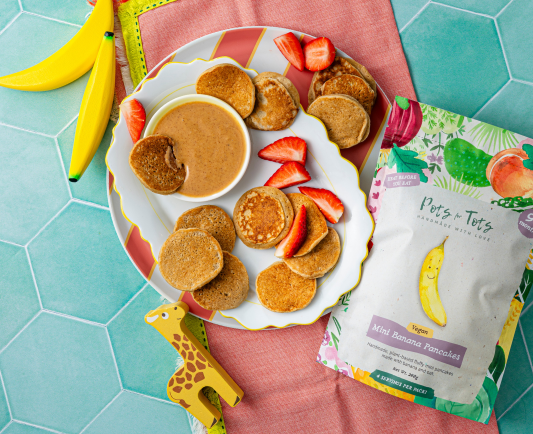
Soft finger foods and snacks work brilliantly alongside utensil practice. Blueberry Mini Muffins are easy to grip, soft enough for little ones to explore and genuinely satisfying to eat independently: a solid option for the days when everything else at the table turns into a floor project.
The less anxious you are about the mess, the more your toddler can relax into exploring. That's not always easy to manage, but it makes a real difference to how mealtimes feel for both of you.
Hand-Feeding to Utensil Use: The Transition
Most toddlers hand-feed and use a spoon or fork simultaneously for many months. They don't simply stop using their hands once they can manage a utensil. They mix and match depending on what they're eating, how hungry they are and how they're feeling that day.
The most effective approach is gentle encouragement without pressure. Eat alongside them and use a spoon, fork and knife yourself. Modelling is genuinely one of the strongest tools at this age, as children learn by what they see others do. Offer the spoon at the start of a meal, pre-load it, hand it over and step back. If they drop it and reach in with their hands, let them.
Some meals invite utensil practice more naturally. My First Pasta Bolognese is a great fork-practice meal once your toddler starts showing interest: the pasta pieces give them something to aim for, and the sauce makes it satisfying to get a forkful right.
When to Help, When to Let Go, When to Laugh
Loading a spoon, steadying the bowl, guiding their hand toward their mouth: none of this undoes the learning. It's scaffolding. You're making success feel achievable while they build the coordination for the full independent version. Stepping in when your toddler is frustrated is exactly the right call.
The times to step back are when they're exploring happily, even chaotically. No frustration means they don't need your help, even if you're watching a perfectly good meal gradually become a floor project.
On the days when you just want something easy to hand your little one, have a browse through our meals and snacks, or Build Your Box with the options they already love.